Multilayer Tarpaulin vs. Cross-Laminated Tarpaulins: Which One Do You Need?
Introduction
When the monsoon clouds gather over the Bay of Bengal, or when the scorching summer sun hits the plains of Central India, the safety of your harvested crops, industrial machinery, and raw materials often depends on one thin layer of protection: your tarpaulin. But with so many options in the market—HDPE, LDPE, Multilayer, Cross-laminated—how do you choose the right one?
At Malsons Polymers, we believe an informed customer is our best customer. In this comprehensive guide, we break down the differences between our two flagship technologies: Micropaulin (Multilayer) and Crosspaulin (Cross-Laminated) to help you make the right choice.
Understanding Multilayer Tarpaulins (Micropaulin®)
Multilayer tarpaulins are the modern evolution of the traditional plastic sheet. Unlike simple monolayer sheets which can crack easily, Micropaulin® is manufactured using a co-extrusion process that fuses multiple layers of polymer into a single sheet.
- The Structure: Typically consists of a core layer for strength, sandwiched between outer layers designed for UV resistance and waterproofing.
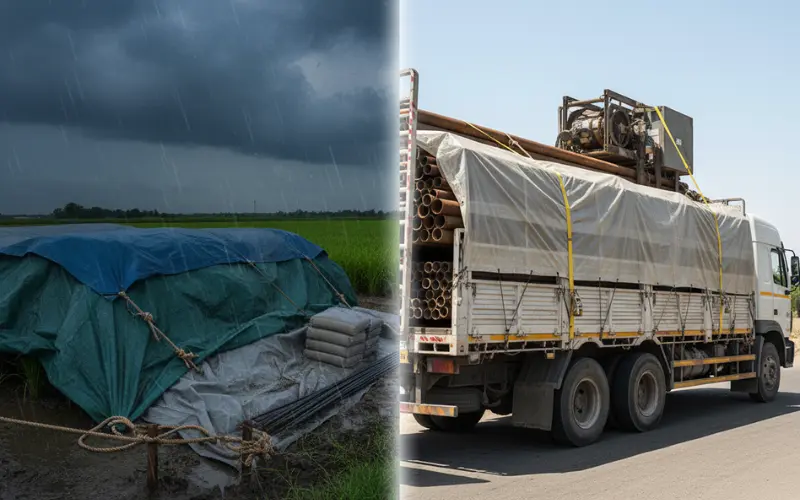
- Best Used For: General waterproofing, covering haystacks, monsoon sheds for homes, covering cement bags at construction sites, and poultry curtains.
- The Malsons Edge: Our Micropaulin ranges from 90 GSM to 300 GSM, offering a weight for every need. It is UV stabilized, meaning it won't degrade after a few months in the sun.
The Science of Cross-Lamination (Crosspaulin™)
If you need strength that goes beyond the ordinary, you need Cross-Lamination. Imagine a fabric woven so tightly and bonded so securely that even if you stab it with a pen, the hole refuses to grow.
- The Technology: We take high-grade polymer films and bond them with their grain directions running crisscross (at 90 degrees) to each other. This creates a bi-axial orientation that offers incredible structural integrity.
- The "Tear-Lock" Advantage: The biggest failure point of a tarp is a tear that spreads. In Crosspaulin, the cross-grained structure "locks" the tear in place.
- Best Used For: Heavy-duty trucking (where wind flaps the tarp violently), covering sharp industrial goods, canal lining, and disaster relief tents.
Choosing the Right GSM
- Light Duty (70-90 GSM): Temporary covers, painting drop sheets.
- Medium Duty (120-150 GSM): Agriculture covers, market stall covers.
- Heavy Duty (200+ GSM): Truck covers, pond liners, long-term outdoor storage.
Conclusion
Whether you choose the versatile Micropaulin for your farm or the invincible Crosspaulin for your truck, you are choosing a legacy of quality from Malsons Polymers Ltd. Don't compromise on protection—choose the strength that is "Ummid Se Zyaada."
Explore Crosspaulin Cross-Laminated Sheets
Discover the right product for your application.